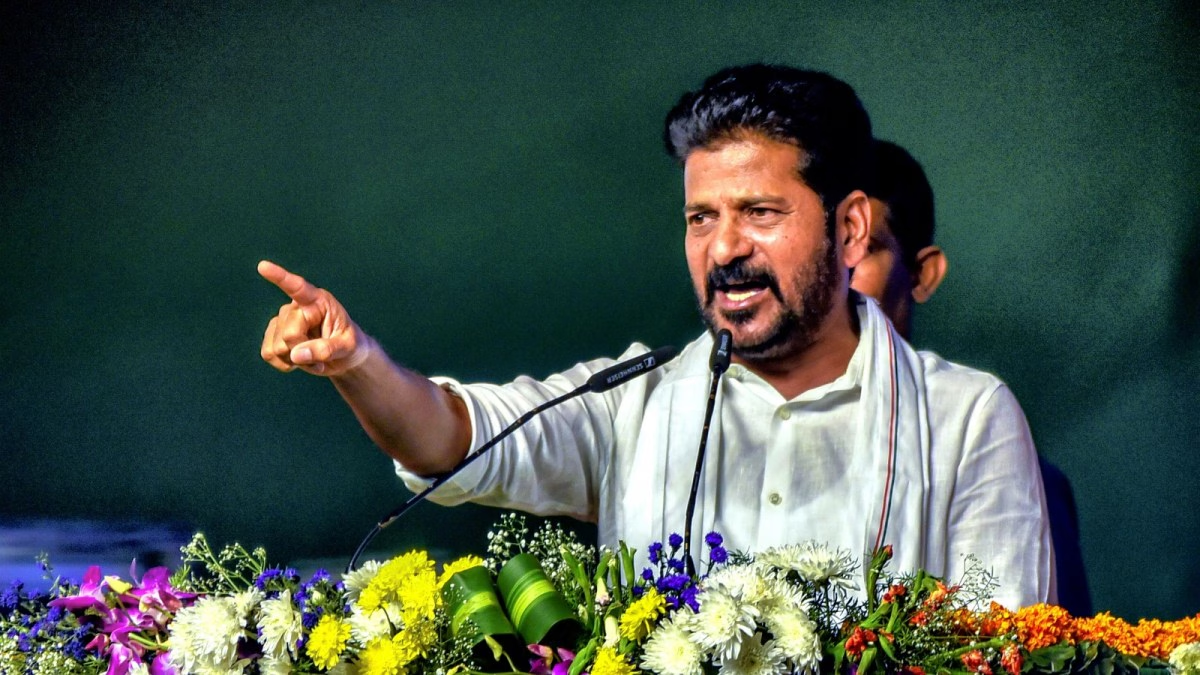

Telangana’s political landscape has shifted significantly in the last few years, and one name now rises above the rest in regional influence: A. Revanth Reddy. He isn’t a Hollywood-style celebrity or a national firebrand. He is a grounded leader who turned grassroots experience into political power, anchoring a larger conversation about the role of southern Telugu leaders in Indian democracy.
Revanth Reddy’s ascent is unexpected by traditional political standards. He came from a farming family in a small Telangana village and entered politics without dynastic backing. Rather than inheriting power, he built credibility step by step — first as a youth leader, then as an MLA, and later in national politics. His path reflects a broader desire for leaders who mirror the lived struggles of everyday citizens.
What makes his story noteworthy is not a single victory but constancy and resilience. In a region long dominated by established parties and personalities, Revanth Reddy managed to reshape perceptions. He first made his mark in the Telugu Desam Party (TDP) before shifting to the Indian National Congress. That move was strategic — one that brought him both challenges and opportunities. Today, as Chief Minister of Telangana, he stands at the helm of governance in a state seeking both economic growth and cultural affirmation.
Telangana itself arrived late on India’s political map, becoming a separate state only in 2014 following a prolonged movement for recognition and self-rule. The movement had deep emotional roots, tied to identity, language, and equitable distribution of resources. It was spearheaded by leaders like K. Chandrashekar Rao (KCR), but the baton eventually passed to a new cohort of leaders who could balance regional pride with aspirations for progress. Revanth Reddy became one of them.
As a leader, Revanth Reddy stands out for blending welfare focus with an appeal to development politics — a balancing act that resonates in both rural and urban constituencies. He advocates for better public services, infrastructure investment, and social schemes, while also pushing for Telangana’s identity to be recognized within the larger Indian framework. This dual approach has helped him connect with a broad base of voters who seek tangible governance outcomes alongside cultural affirmation.
His political narrative is grounded in openness and communication. Unlike leaders who rely solely on rhetoric, Reddy engages with people across the state, from tribal districts to urban centers. His governance style focuses on outreach programs and visible on-ground presence. This has helped him translate public sentiment into political capital, especially among younger voters.
But Revanth’s journey hasn’t been without challenges. The Telugu states — Telangana and Andhra Pradesh — have strong political cultures with deep loyalties to regional parties and identities. Telangana was historically dominated by the Bharat Rashtra Samithi (formerly TRS) under KCR’s leadership, while Andhra Pradesh has alternated between the TDP and the YSR Congress Party (YSRCP). In this landscape, crafting a distinct political identity requires agility and strategic acumen. Revanth Reddy’s success lies in his ability to carve out a space that bridges grassroots activism and administrative command.
At the heart of his appeal is relatability. Revanth comes from modest beginnings, and he speaks directly to the aspirations of ordinary people — farmers, small business owners, and young professionals seeking employment. He often emphasizes that governance should work for those who feel overlooked by traditional political elites. This narrative has particular resonance in a region where development gaps — between urban Hyderabad and rural districts — remain a central concern.
Another dimension of his leadership is his role in renewing Telugu political relevance on the national stage. In recent years, commentators have noted a relative decline in the influence of Telugu leaders at the national level compared to earlier decades when figures like P.V. Narasimha Rao or N.T. Rama Rao played outsized roles in shaping India’s politics. Leaders like Revanth Reddy represent a potential resurgence, signaling that the voices of the Telugu states can still matter beyond regional boundaries.
His leadership also reflects a broader trend in Indian politics: the rise of regional icons who combine local identity with governance priorities. Revanth Reddy’s approach — balancing welfare, identity, and economic focus — is part of a new template for leaders emerging from India’s diverse states. This model is less about personality cults and more about sustained engagement with citizen needs and aspirations.
Reactions to his leadership vary. Supporters see him as a refreshing alternative — a leader who understands the pulse of the people and strives to deliver results. Critics argue that he still faces structural challenges, from opposition parties to entrenched regional interests. Yet, what is clear is that his influence is growing, and his leadership marks a shift in Telugu politics toward a new generation of policymakers.
In the broader context of Indian federal politics, the rise of leaders like Revanth Reddy highlights the ongoing evolution of regionalism and governance. The Telugu states, once viewed as politically distinct but nationally peripheral, are now producing voices that seek both local relevance and national recognition. Whether this translates into broader influence in Indian politics remains to be seen, but Revanth Reddy’s role is already emblematic of a changing political landscape — one that values representation, accountability, and connection with the people.
In the end, Revanth Reddy’s journey is more than a biographical footnote. It is a story about democratic engagement, regional identity, and the rise of leaders who reflect the aspirations of their people. For the Telugu south, his leadership offers a new chapter — one where politics isn’t just about legacy, but about relevance, responsiveness, and renewal.