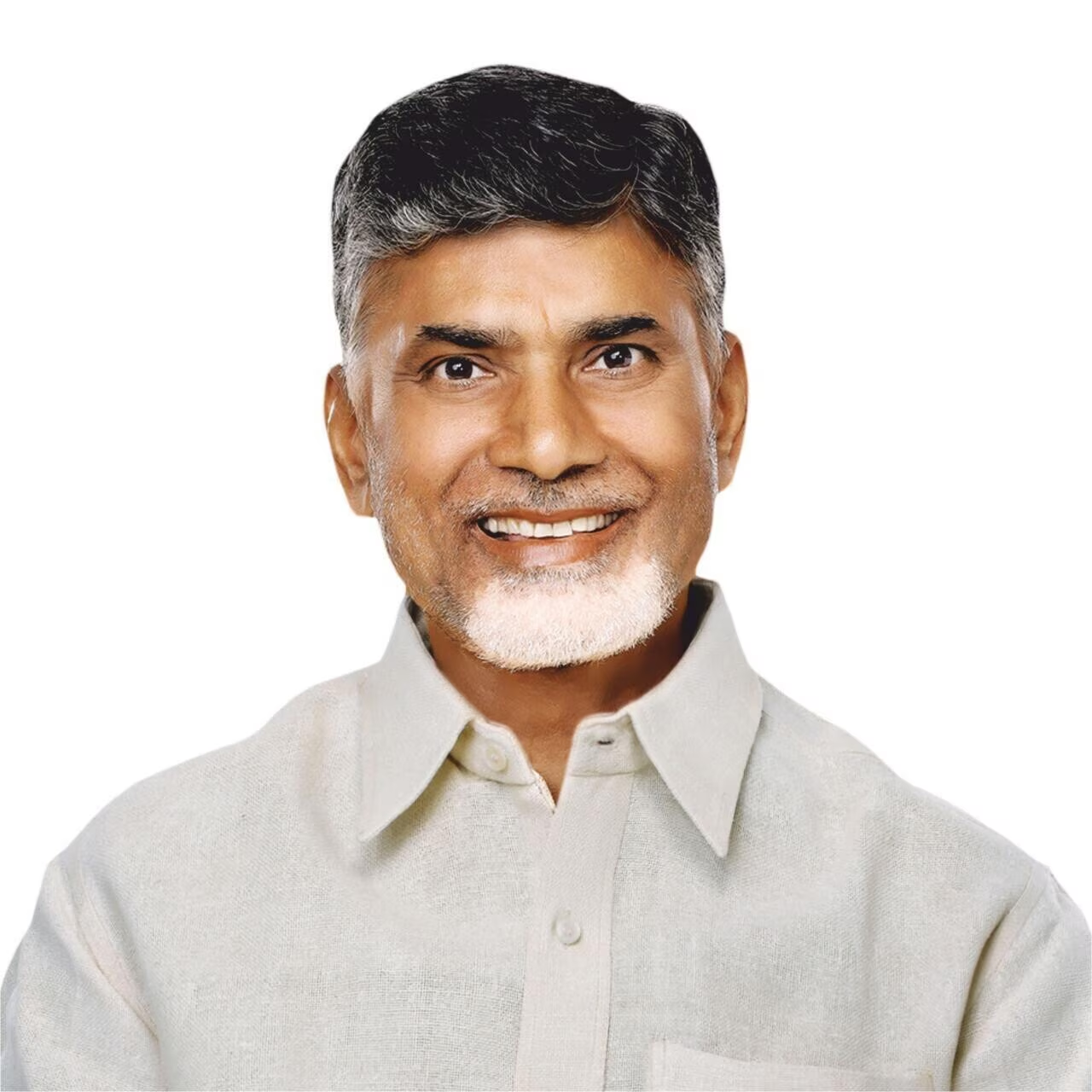

N. Chandrababu Naidu is not the loudest politician in India. He does not dominate prime-time debates, nor does he thrive on constant spectacle. Yet, for nearly three decades, he has remained impossible to erase from Telugu politics. That persistence alone makes him an icon — not of emotion or charisma, but of strategy.
Naidu’s political identity was forged early. He rose during a time when regional leaders were expected to be mass mobilisers first and administrators later. He flipped that equation. Governance, planning, data, and systems became his calling cards. When most leaders spoke in slogans, Naidu spoke in charts.
As Chief Minister of united Andhra Pradesh in the late 1990s, Naidu built a reputation as India’s first true “CEO-style” politician. Hyderabad’s transformation into a technology hub did not happen by accident. It was planned, marketed, and executed with unusual precision for Indian politics of that era. Global investors noticed. So did Indian voters.
But this technocratic style came with a cost. Naidu often struggled to emotionally connect with rural voters who wanted immediacy, not long-term vision. Welfare politics, which later became dominant across India, was never his strongest suit. His focus remained structural — infrastructure, IT parks, institutions. In Indian democracy, that is both a strength and a liability.
The bifurcation of Andhra Pradesh in 2014 marked a defining moment. While Telangana emerged with Hyderabad, Andhra Pradesh was left to rebuild from scratch. Naidu returned to power promising to reimagine the state — new capital, new economy, new identity. Amaravati symbolised that ambition. It also exposed the risks of big-vision politics without broad consensus.
Critics argue that Naidu over-promised and under-delivered during this phase. Supporters counter that he was constrained by political hostility and limited resources. Both views hold truth. What is undeniable is that Naidu chose the harder path — attempting long-term institutional creation instead of short-term populism.
His 2019 electoral defeat was brutal. Many assumed it marked the end. In Telugu politics, comebacks are rare and unforgiving. But Naidu did what he has always done best — waited, recalibrated, and rebuilt alliances. The 2024 return, with a strengthened mandate, reaffirmed a simple political reality: experience still matters.
Naidu’s relevance today lies less in personal popularity and more in contrast. Against leaders who centralise power and govern through personality, he represents process. Against welfare-heavy governance, he argues for sustainability. Against impulsive politics, he insists on planning.
This makes him an unusual icon. He is admired more by administrators, entrepreneurs, and policy thinkers than by crowds chanting slogans. His speeches are dense. His interviews are technical. His politics demands patience — a rare commodity in today’s attention economy.
Yet, Telugu politics would be poorer without him. Naidu introduced the idea that a Chief Minister could be judged by metrics, not just emotions. He forced conversations about urban planning, digital governance, and institutional capacity long before these became fashionable nationally.
At the same time, his journey also serves as a cautionary tale. Vision without emotional connect struggles in mass democracy. Data cannot fully replace trust. Growth narratives must coexist with welfare realities, especially in agrarian regions.
What keeps Chandrababu Naidu relevant is not nostalgia, but necessity. Andhra Pradesh’s future still requires structured thinking, fiscal discipline, and long-term planning. Few regional leaders possess that toolkit at his scale.
Icons are not always beloved. Some are respected. Some are endured. Some are repeatedly underestimated. Chandrababu Naidu belongs to the last category.
In a political era dominated by immediacy, his continued presence is a reminder that democracy also needs architects — not just performers.