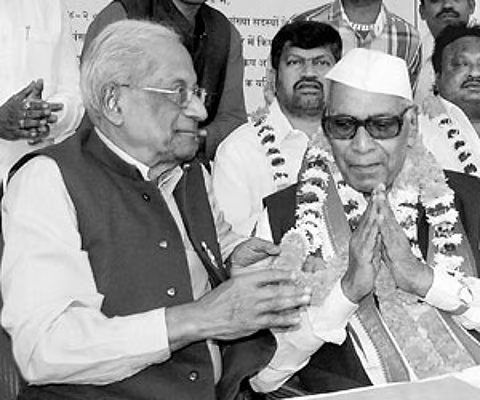

Konda Laxman Bapuji was never a headline-chasing politician. He did not cultivate spectacle, nor did he command power through electoral dominance or mass theatrics. Yet, few individuals influenced the intellectual, cultural, and ideological foundations of the Telangana movement as deeply as he did. In many ways, Bapuji represents the kind of leadership India often overlooks—quiet, principled, rooted in social justice, and unwavering even when history chose louder voices.
Early life shaped by inequality
Born in 1915 in a small village in what is now Telangana, Konda Laxman Bapuji grew up witnessing caste discrimination, feudal oppression, and regional neglect firsthand. These were not abstract injustices discussed in academic circles; they were lived realities. Landlords wielded unchecked power, Dalits were systematically excluded, and Telangana’s agrarian society remained trapped in inequality under the Nizam’s rule.
Unlike many leaders who entered politics through privilege, Bapuji’s political consciousness emerged from lived experience. Education exposed him to reformist ideas, but it was social reality that radicalised him. From early on, he believed that political freedom without social justice was hollow.
The Telangana Armed Struggle and moral clarity
Bapuji’s role in the Telangana Armed Struggle (1946–1951) remains one of the most understated chapters of his life. While history often reduces the movement to ideology or violence, Bapuji viewed it as an assertion of dignity by the rural poor against feudal exploitation.
What set him apart was not militancy but moral clarity. Even during a time when revolutionary fervour dominated, Bapuji consistently argued for people-centric outcomes rather than ideological purity. He supported resistance against injustice but remained deeply uneasy with violence becoming an end in itself. This internal tension—between resistance and restraint—defined his politics.
Voice of Telangana within Andhra politics
After the integration of Hyderabad State into Andhra Pradesh in 1956, Telangana’s grievances were quickly sidelined. Political power shifted, resources were reallocated, and assurances given during the merger were diluted or ignored. While many leaders adapted to the new political reality, Bapuji refused to remain silent.
Within the Congress party, he emerged as one of the earliest and most consistent voices warning that regional imbalance would fracture Andhra Pradesh. Long before Telangana became an electoral slogan, Bapuji framed it as an issue of constitutional fairness, administrative equity, and cultural respect.
He was not confrontational by temperament. Instead, he used reasoned arguments, internal memoranda, and legislative interventions. This approach did not make him popular within party power structures—but it made him indispensable to Telangana’s political memory.
Champion of Dalit assertion
Perhaps Bapuji’s most enduring legacy lies in Dalit empowerment. At a time when Dalit politics was either co-opted or suppressed, he insisted on autonomy and self-respect. He encouraged Dalits to see themselves not merely as beneficiaries of reform, but as political actors.
His involvement with social reform movements went beyond symbolism. He supported land redistribution, access to education, and political representation for marginalised communities. Unlike leaders who discovered social justice later in life, Bapuji’s politics began and ended with it.
A leader without hunger for office
One of the reasons Konda Laxman Bapuji remains under-celebrated is precisely because he never sought personal power aggressively. He held positions, contested elections, and served in legislatures—but office was never the objective.
This made him politically inconvenient. He could not be easily bought, silenced, or repositioned. When party decisions conflicted with Telangana’s interests, he spoke out—even at the cost of isolation. In an ecosystem where loyalty is often rewarded over integrity, Bapuji chose the harder path.
Mentor to a generation
Behind the scenes, Bapuji shaped several leaders who would later dominate Telangana’s political narrative. His home was a space for debate, ideological grounding, and political education. Many who later took center stage drew from frameworks he articulated decades earlier.
Yet, he rarely claimed credit. In fact, he seemed comfortable fading into the background as long as the ideas survived. This self-effacement, admirable as it is, also explains why history has not foregrounded him.
Telangana realised, but without him
When Telangana finally became a separate state in 2014, Bapuji was no longer alive to witness it. The moment was marked by celebration, speeches, and symbolism—but little reflection on the intellectual labour that sustained the movement during its leanest decades.
Many slogans echoed ideas Bapuji had articulated when Telangana had no electoral currency. Many arguments presented as contemporary had been made by him when they carried political risk.
Why Konda Laxman Bapuji matters today
In an era dominated by personality-driven politics, Bapuji’s life offers a counter-model: leadership grounded in values rather than visibility. He reminds us that movements are not built only by those who cross the finish line, but by those who keep the flame alive when victory seems impossible.
For Telangana—and for India—Konda Laxman Bapuji represents the kind of icon who does not fit neatly into celebratory narratives, but without whom those narratives would collapse.
He was not loud.
He was not transactional.
He was not temporary.
He was foundational.