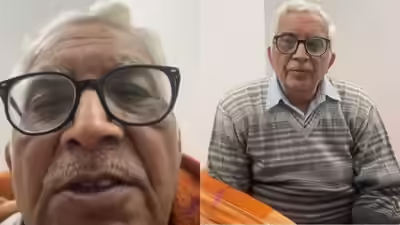

If you had told someone a year ago that a 70-year-old Indian man would become one of the most talked-about internet figures this week, they might have laughed. Then came Vinod Kumar Sharma’s first vlog — raw, unpolished, spontaneous — and boom. Millions of people tuned in within 72 hours. “Dada ji,” they called him. Genuine. Honest. Beloved almost instantly.
This isn’t a celebrity launch or influencer playbook. There were no scripts, no glossy edits, no brand partnerships. There was just Vinod Kumar Sharma being exactly who he is. And that’s what made people stop scrolling.
In a world dominated by perfectly curated feeds, hyper-produced reels, and endless ads for things we don’t need, suddenly seeing a video that felt human stood out like a splash of cold water. You could feel it in the comments — people weren’t just reacting, they were responding. They saw themselves, their parents, their grandparents. They saw a reminder that life doesn’t have to be staged to matter.
Social media has trained us to expect polished personalities. Every feed can start to feel like one long recruitment ad for perfection. But when Vinod shows up — a man who has lived more life than most influencers have followers — it throws that entire illusion off balance.
Why did this resonate so widely?
Because authenticity is rare. We chase trends that tell us how to dress, what to buy, how to behave, and what to feel. But then here comes someone who didn’t chase anything — he just shared a moment from his life — and the internet ate it up. Not as a meme. Not as a joke. As something real and refreshingly sincere.
And there’s something deeply human in that. We want connection, not perfection. We crave stories that feel like they could happen to us. Vinod’s sudden fame isn’t just a viral anomaly — it shows a shift in what people actually value online: transparency over gloss, vulnerability over polish.
But there’s also another layer here that matters. It’s not just that his video was genuine. It’s that people across age groups rallied around it. Not only Gen Z or millennials — even older viewers found something reassuring in it. In an attention economy that so often marginalises voices outside a young demographic, this is significant.
Vinod didn’t go viral because he was funny or outrageous. He went viral because he was present. A man with a story, a voice, and a moment that didn’t feel engineered. In the age of staged authenticity — where even “candid” takes are carefully scripted — that’s a rare phenomenon.
Some will call this a quirky internet moment. Others might see it as evidence that the algorithm can still surprise us. But another truth lies beneath: people are hungry for content that feels real. They are tired of filtered idealism packaged as reality. They want the everyday experience. And when they get it, they reward it with attention.
That’s the unusual power of Vinod Kumar Sharma’s viral rise. It’s a reminder that in a landscape dominated by performance, being yourself can still break through — and maybe that’s the most profound lesson of all.
In a digital age structured around amplification and optimization, sometimes raw cuts through refined. And sometimes human trumps hype.
This week, social media chose human.